




The
The
How will
How will
Field Guide
Field Guide
you transform
you transform
to
to
your
your
Compliance AI
Compliance AI
program?
program?
How will you transform your program?

WHAT
WE BELIEVE
03 / 03
Build change steadily through targeted shifts and continuous improvement.

WHAT
WE BELIEVE
02 / 03
Maintain systems that are transparent, context-rich, and provable.

WHAT
WE BELIEVE
01 / 03
Scale the work, but keep the judgment.
See a demo promising a single agent that can “do it all.”
See a demo promising a single agent that can “do it all.”
Hear someone say, “we’ll completely transform your program in 6 months.”
Hear someone say, “we’ll completely transform your program in 6 months.”
See teams implementing AI workflows over the same deficient data.
See teams implementing AI workflows over the same deficient data.
Here's what we'll be breaking down
Here's what we'll be breaking down
01
The case for
The case for
AI in compliance
AI in compliance
99%
time-intensive,
repetitive taskwork
99%
time-intensive,
repetitive taskwork
1%
cases requiring skilled investigator intelligence and specialized training
1%
cases requiring skilled investigator intelligence and specialized training
WORKING WITH AI
WORKING WITHOUT AI
No compliance program should have to depend on the superhuman effort of its investigators simply to do what its program demands.
AI transforms human investigators from task managers into risk managers.
No compliance program should have to depend on the superhuman effort of its investigators simply to do what its program demands.
AI transforms human investigators from task managers into risk managers.
Employing highly trained investigators to do repetitive tasks from a known playbook is a waste of money and expertise. It results in slow, inefficient compliance. And forces the entire team to work harder to less effect.
Employing highly trained investigators to do repetitive tasks from a known playbook is a waste of money and expertise. It results in slow, inefficient compliance. And forces the entire team to work harder to less effect.
Effective teams say...
Do the work that makes a difference.
Remove business bottlenecks.
Pursue the complex cases.
Effective teams say...
Do the work that makes a difference.
Remove business bottlenecks.
Pursue the complex cases.
Inefficient teams say...
We can't afford to go the extra mile.
We don't have resources to follow that lead.
We don't have time to check that.
Inefficient teams say...
We can't afford to go the extra mile.
We don't have resources to follow that lead.
We don't have time to check that.





Let’s pause for a second.
How’s all this sitting with you?
Let’s pause for a second.
How’s all this sitting with you?
02
Where teams
Where teams
go wrong
go wrong

Privacy
Privacy
Privacy

Context
Context
Context


Proof
Proof
Proof

Control
Control

MYTH
01
A good enough model will be able to just “figure it out.”
WHY IT'S WRONG
AI doesn’t know what it doesn’t have access to.
LET US EXPLAIN
Missing context is the Achilles heel of all AI tools. And in compliance (where context is everything but data is often siloed) this is the main obstacle to be overcome. The success of your AI transformation plan is dictated by how successfully you’re able to give your AI model access to the right information.

MYTH
02
Automation compromises controls and reduces oversight
WHY IT'S WRONG
Automated processes require quality controls as a prerequisite.
LET US EXPLAIN
Every compliance team needs to be able to look at a case, understand what was considered, and understand the logic of the decision. That doesn’t change whether it’s human involvement or an automated process. If your automation tools give you transparency and customizability, they’re going to increase your level of control.

MYTH
03
Human-in-the-loop is a checkbox
WHY IT'S WRONG
Human-in-the-loop as a workflow step misses the point. Human direction of AI should be constant: from designing agentic workflows to QA/QC of outputs.
LET US EXPLAIN
Unlike consumer AI products, compliance AI has to do more than just produce outputs – it also needs to provide a record of the steps it took to reach its conclusions. This requires more specialized configuration and tuning, but the increased speed, scalability, and consistency of AI workflows make it worthwhile.

MYTH
04
Going “big” is the only way to get transformational ROI
WHY IT'S WRONG
AI is not a single “project” any more than compliance work is a single task. True AI transformation is adaptation to a new way of working.
LET US EXPLAIN
Steady and consistent wins this race. The safest (and most effective!) way to bring AI change to compliance is through small and methodical improvements. Increased automation of individual workflows allows you to string them together incrementally. As changes link, AI’s impact on the program increases exponentially.

MYTH
01
A good enough model will be able to just “figure it out.”
WHY IT'S WRONG
AI doesn’t know what it doesn’t have access to.
LET US EXPLAIN
Missing context is the Achilles heel of all AI tools. And in compliance (where context is everything but data is often siloed) this is the main obstacle to be overcome. The success of your AI transformation plan is dictated by how successfully you’re able to give your AI model access to the right information.

MYTH
02
Automation compromises controls and reduces oversight
WHY IT'S WRONG
Automated processes require quality controls as a prerequisite.
LET US EXPLAIN
Every compliance team needs to be able to look at a case, understand what was considered, and understand the logic of the decision. That doesn’t change whether it’s human involvement or an automated process. If your automation tools give you transparency and customizability, they’re going to increase your level of control.

MYTH
03
Human-in-the-loop is a checkbox
WHY IT'S WRONG
Human-in-the-loop as a workflow step misses the point. Human direction of AI should be constant: from designing agentic workflows to QA/QC of outputs.
LET US EXPLAIN
Unlike consumer AI products, compliance AI has to do more than just produce outputs – it also needs to provide a record of the steps it took to reach its conclusions. This requires more specialized configuration and tuning, but the increased speed, scalability, and consistency of AI workflows make it worthwhile.

MYTH
04
Going “big” is the only way to get transformational ROI
WHY IT'S WRONG
AI is not a single “project” any more than compliance work is a single task. True AI transformation is adaptation to a new way of working.
LET US EXPLAIN
Steady and consistent wins this race. The safest (and most effective!) way to bring AI change to compliance is through small and methodical improvements. Increased automation of individual workflows allows you to string them together incrementally. As changes link, AI’s impact on the program increases exponentially.
So intead of asking...
Can we just prompt it better?
Which model is best?
How smart is the model?
Ask instead...
Can we test before we ship?
Can we trace decision-making?
Can it access the right data?
Now, what will it take to move your program forward?
Now, what will it take to move your program forward?
03
Gaining an
Gaining an
edge with an AI
edge with an AI
operating model
operating model
AI handles the volume
while humans own the risk

LAYER
01
: WORK
AI owns repeatable playbooks, taskwork, and lower-level workflows
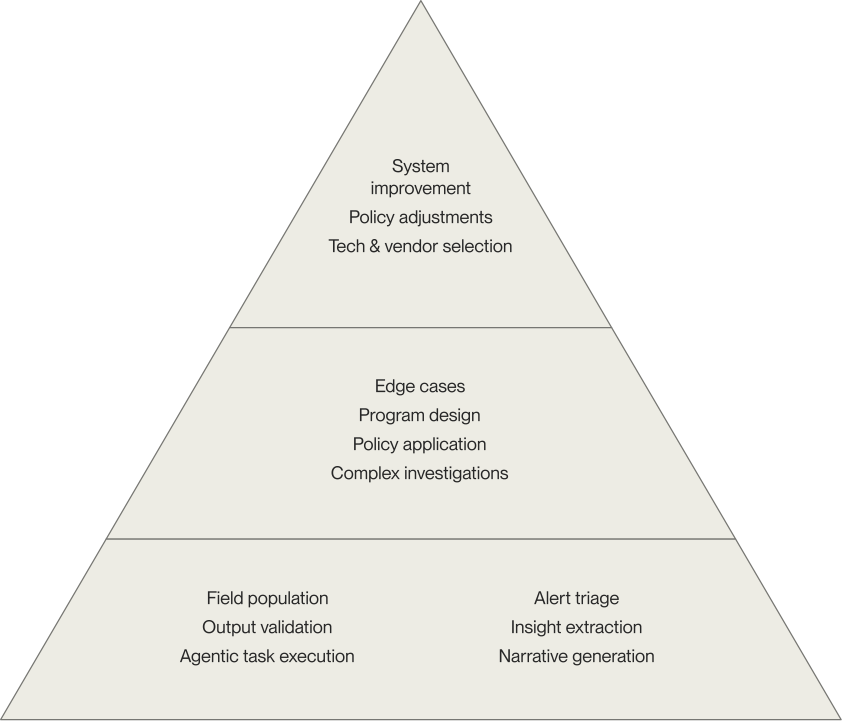
Here’s where you want AI taking charge of execution, flagging and triaging alerts, extracting relevant details, populating templates. Looking, summarizing, drafting. This is where you’re leading with AI – not because it’s smarter than a human – but because it’s always consistent, always available, and always ready for fine-tuning.
LAYER
01
: WORK
AI owns repeatable playbooks, taskwork, and lower-level workflows
Here’s where you want AI taking charge of execution, flagging and triaging alerts, extracting relevant details, populating templates. Looking, summarizing, drafting. This is where you’re leading with AI – not because it’s smarter than a human – but because it’s always consistent, always available, and always ready for fine-tuning.
LAYER
02
: EXPERTISE
Human expertise drives the program design and manages the risk portfolio
This is where your expertise belongs – both in handling case escalations and managing program performance. It’s where your human investigators resolve ambiguities, review edge cases, chase complex investigations, and make high-impact decisions. It’s where you run continuous program diagnostics and QA AI output. This is where your human team leads the charge. Because human judgment is what’s required, and some context can’t be found in the data.
LAYER
02
: EXPERTISE
Human expertise drives the program design and manages the risk portfolio
This is where your expertise belongs – both in handling case escalations and managing program performance. It’s where your human investigators resolve ambiguities, review edge cases, chase complex investigations, and make high-impact decisions. It’s where you run continuous program diagnostics and QA AI output. This is where your human team leads the charge. Because human judgment is what’s required, and some context can’t be found in the data.
LAYER
03
: LEADERSHIP
Leadership focuses on continuous system improvement
The lynchpin layer (and yet the one most teams ignore!) is where you convert your AI output into a feedback and refinement loop – one that ensures that your program is protected, productive, and constantly evolving. You’re looking at what was accepted, what was corrected, what was escalated, what new patterns appeared. That data is fuel for the adaptation engine for iterative improvements: adjusted workflows, policy refinements, new evaluation criteria – and more.
LAYER
03
: LEADERSHIP
Leadership focuses on continuous system improvement
The lynchpin layer (and yet the one most teams ignore!) is where you convert your AI output into a feedback and refinement loop – one that ensures that your program is protected, productive, and constantly evolving. You’re looking at what was accepted, what was corrected, what was escalated, what new patterns appeared. That data is fuel for the adaptation engine for iterative improvements: adjusted workflows, policy refinements, new evaluation criteria – and more.


LEADERSHIP

HUMAN EXPERTISE

AI
WHY IT MATTERS
This is where the program is shaped. Leaders determine how a program will scale, how teams and tech are organized, and how success is measured, ensuring that AI and humans operate as a coordinated system, not a pile of tools.
WHY IT MATTERS
This is where expertise lives. Humans handle edge cases, apply context the data can't capture, and pursue complex investigations – making the high-impact calls that protect the program.
WHY IT MATTERS
AI shines on repeatable work with clearly defined goals. It executes consistently at scale – flagging, summarizing, and preparing casework – so your team can spend time where human judgment makes the difference.
LEADERSHIP
HUMAN EXPERTISE
AI
WHY IT MATTERS
This is where the program is shaped. Leaders determine how a program will scale, how teams and tech are organized, and how success is measured, ensuring that AI and humans operate as a coordinated system, not a pile of tools.
WHY IT MATTERS
This is where expertise lives. Humans handle edge cases, apply context the data can't capture, and pursue complex investigations – making the high-impact calls that protect the program.
WHY IT MATTERS
AI shines on repeatable work with clearly defined goals. It executes consistently at scale – flagging, summarizing, and preparing casework – so your team can spend time where human judgment makes the difference.
LEADERSHIP
HUMAN EXPERTISE
AI
WHY IT MATTERS
This is where the program is shaped. Leaders determine how a program will scale, how teams and tech are organized, and how success is measured, ensuring that AI and humans operate as a coordinated system, not a pile of tools.
WHY IT MATTERS
This is where expertise lives. Humans handle edge cases, apply context the data can't capture, and pursue complex investigations – making the high-impact calls that protect the program.
WHY IT MATTERS
AI shines on repeatable work with clearly defined goals. It executes consistently at scale – flagging, summarizing, and preparing casework – so your team can spend time where human judgment makes the difference.
Free from repetitive taskwork, your leaner, AI-enabled team will work on more important things, such as…
Complex cases
Escalation decisions
Output QA and program monitoring
Workflow design
Efficiency and effectiveness monitoring

We showed you our operating model diagram. But what's your favorite visual framework?
We showed you our operating model diagram. But what's your favorite visual framework?


04
How to
How to
deliver
deliver
In the real world, the success or failure of AI in a compliance setting depends on your ability to bridge the gap between…
Technical Capability
Technical Capability
Practical Applicability
Practical Applicability
Let’s open the Implementation Playbook.

PLAY
01
Prioritize
and get a boring win early
WHAT'S THE PLAY?
Fact. You WILL be tempted to start with your most ambitious use case.
Don't.
Instead, look for a workflow that’s high-volume, bounded, repeatable, reviewable, and that comes from a clearly defined playbook.
WHY DOES IT WORK?
Identifying your highest-volume existing workflows allows you to define the decision points, inputs, data dependencies, and expected outputs. By choosing to begin with a narrow set of tasks with clear success criteria, you minimize risk and provide your team with a repeatable (and expandable!) process for rolling out AI features.
Make your first win a boring one. Because boring is where you can define and measure success.
PLAY
02
Prepare
to close the context gap
WHAT'S THE PLAY?
Like any road trip, AI implementation benefits from a good roadmap.
Want to get where you’re going? Plot out the steps in the workflows you’re looking to automate.
ASK YOURSELF
Which systems
are involved?
WHY DOES IT WORK?
Remember: AI is only as effective as the data, context, and systems it has access to. In order to deliver high-quality, reliable output, AI needs to be fueled with information. AI models can reason through ambiguous data and across systems, but it can’t know what it can’t see.
Don’t give AI access to everything. But make sure it has access to what it needs to perform.
PLAY
03
Build
while wearing your hard hat
WHAT'S THE PLAY?
Build! Make your planning and pre-work a reality.
But don’t forget: just like any construction zone, you should always do your building in a safe environment.
WHY DOES IT WORK?
If you want to redecorate your home, you don’t build your new furniture in the existing kitchen. Having a workshop (what in software we call a sandbox environment) is essential for the smooth rollout of new features. A sandbox or testing environment is what allows you to run tests, inspect inputs and outputs, measure performance, and establish an effective baseline.
PLAY
04
QA
and then QA some more
WHAT'S THE PLAY?
When you QA AI results, you're not just doing QA.
You're training the system.
That's why we recommend going big on QA-ing early results.
(We're talking 100%)
WHY DOES IT WORK?
Think of it this way: you wouldn’t simply set a new employee loose on your cases unsupervised, so why would you with AI? In either case, it’s best to make sure they’re getting the hang of your institution’s policies and procedures. Actively QA-ing AI outputs – especially early on – will ensure you and the AI are in lockstep regarding prompt behavior, escalation logic, and the definition of “done.”
Over time, you’ll be able to reduce your QA oversight.
Once the quality of the output indicates that the system has earned it!
PLAY
05
Measure and Monitor
what matters
WHAT'S THE PLAY?
Metrics are essential to any initiative's success — including AI.
But make sure you avoid the vanity metrics. After all, AI can easily boost your output numbers.
But that won't guarantee your program success.
WHY DOES IT WORK?
The metrics you need to look at for your AI implementation sit underneath those high-level program numbers. In particular, we recommend looking at your T.R.A.C.
THROUGHPUT
How many tasks are you effectively automating?
RELIABILITY
What is your task completion rate?
ADHERENCE
How consistently do AI outputs follow SOPs, templates, and policy constraints?
CORRECTNESS
What number of completed requests are accepted? (Expressed as the percent approved by a human reviewer.)
Keep an eye on these metrics, and your AI implementation is sure to stay on “TRAC”.
PLAY
06
Establish, Expand, and Compound
WHAT'S THE PLAY?
This is where the magic of this approach comes into play.
Because once you've gotten your first AI-enabled workflow up and running. You're on to the next — it's exponential performance, with compounded success.
WHY DOES IT WORK?
Taking a measured, step-by-step approach to implementation is how teams stop looking at AI like a one-off project, and start viewing it like an integral part of how they run their program.
PLAY
01
Prioritize
and get a boring win early
WHAT'S THE PLAY?
Fact. You WILL be tempted to start with your most ambitious use case.
Don't.
Instead, look for a workflow that’s high-volume, bounded, repeatable, reviewable, and that comes from a clearly defined playbook.
WHY DOES IT WORK?
Identifying your highest-volume existing workflows allows you to define the decision points, inputs, data dependencies, and expected outputs. By choosing to begin with a narrow set of tasks with clear success criteria, you minimize risk and provide your team with a repeatable (and expandable!) process for rolling out AI features.
Make your first win a boring one. Because boring is where you can define and measure success.
PLAY
02
Prepare
to close the context gap
WHAT'S THE PLAY?
Like any road trip, AI implementation benefits from a good roadmap.
Want to get where you’re going? Plot out the steps in the workflows you’re looking to automate.
ASK YOURSELF
Which systems
are involved?
WHY DOES IT WORK?
Remember: AI is only as effective as the data, context, and systems it has access to. In order to deliver high-quality, reliable output, AI needs to be fueled with information. AI models can reason through ambiguous data and across systems, but it can’t know what it can’t see.
Don’t give AI access to everything. But make sure it has access to what it needs to perform.
PLAY
03
Build
while wearing your hard hat
WHAT'S THE PLAY?
Build! Make your planning and pre-work a reality.
But don’t forget: just like any construction zone, you should always do your building in a safe environment.
WHY DOES IT WORK?
If you want to redecorate your home, you don’t build your new furniture in the existing kitchen. Having a workshop (what in software we call a sandbox environment) is essential for the smooth rollout of new features. A sandbox or testing environment is what allows you to run tests, inspect inputs and outputs, measure performance, and establish an effective baseline.
PLAY
04
QA
and then QA some more
WHAT'S THE PLAY?
When you QA AI results, you're not just doing QA.
You're training the system.
That's why we recommend going big on QA-ing early results.
(We're talking 100%)
WHY DOES IT WORK?
Think of it this way: you wouldn’t simply set a new employee loose on your cases unsupervised, so why would you with AI? In either case, it’s best to make sure they’re getting the hang of your institution’s policies and procedures. Actively QA-ing AI outputs – especially early on – will ensure you and the AI are in lockstep regarding prompt behavior, escalation logic, and the definition of “done.”
Over time, you’ll be able to reduce your QA oversight.
Once the quality of the output indicates that the system has earned it!
PLAY
05
Measure and Monitor
what matters
WHAT'S THE PLAY?
Metrics are essential to any initiative's success — including AI.
But make sure you avoid the vanity metrics. After all, AI can easily boost your output numbers.
But that won't guarantee your program success.
WHY DOES IT WORK?
The metrics you need to look at for your AI implementation sit underneath those high-level program numbers. In particular, we recommend looking at your T.R.A.C.
THROUGHPUT
How many tasks are you effectively automating?
RELIABILITY
What is your task completion rate?
ADHERENCE
How consistently do AI outputs follow SOPs, templates, and policy constraints?
CORRECTNESS
What number of completed requests are accepted? (Expressed as the percent approved by a human reviewer.)
Keep an eye on these metrics, and your AI implementation is sure to stay on “TRAC”.
PLAY
06
Establish, Expand, and Compound
WHAT'S THE PLAY?
This is where the magic of this approach comes into play.
Because once you've gotten your first AI-enabled workflow up and running. You're on to the next — it's exponential performance, with compounded success.
WHY DOES IT WORK?
Taking a measured, step-by-step approach to implementation is how teams stop looking at AI like a one-off project, and start viewing it like an integral part of how they run their program.
Now that we’ve walked through the playbook, tell me:
What do you think the compliance AI tech stack should include?
Now that we’ve walked through the playbook, tell me:
What do you think the compliance AI tech stack should include?
Scaling
Scaling
Success
Success
But here's the thing. You have a role in how it happens. The decisions you make about how to bring AI into your program make are the difference between AI being…

A new source of risk

OR

The thing compliance has needed for years

WHAT
WE BELIEVE
03 / 03
Build safely. Start small and you'll transform your program faster than you think.
WHAT
WE BELIEVE
02 / 03
Make trust and security foundational, with the right context, controls, and oversight.
WHAT
WE BELIEVE
01 / 03
Let AI handle the volume. Turn task managers into risk managers.
Want this guide, wrapped up and ready to share?

Download our Field Guide to Compliance AI.
We’ve put everything here (plus some fun extras!) into a clear, implementation-first guide for building compliance AI that scales.


©2026 Hummingbird. All rights reserved.